

Wood is the most widely available building material derived from a renewable source.

Sustainable management of forests and plantations is the only efficient way to meet society’s demand for wood in perpetuity.

Forests themselves are able to be replenished, since the major inputs that contribute to their growth are sunlight (energy), air, water, and nutrients from soils in which they grow.

It is therefore vital that forests are carefully managed to avoid over-harvesting and that man’s intervention does not reduce the sustainable, long term potential of the resource. If we ensure that forests are regenerated after each harvest of wood products, they will be around for future generations to use and enjoy.

It has been estimated that around 40% of Australia’s forests and woodlands have been harvested for wood and timber at some stage over the past 200-years, but remain essentially intact (State of the Forests Report, BRS, 2003).

Of Australia’s 147 million hectares of native forests (2008 data) around 20% is now managed primarily for conservation in formal nature conservation reserves and national parks on public land, and conservation covenants and other reserves on lease-hold and private land. In addition, huge areas of other forest that is not formally reserved, is effectively reserved by being unsuitable or too remote for resource use.

Most native hardwood production occurs within just the 6% of forest on public land designated as State Forest for multiple uses, although only about half of this is actually being managed for sustainable timber supply due to productivity constraints and management reserves. Timber production in these multiple use State Forests is conducted on a sustainable basis because state government agencies have gathered sufficient data about forest growth and productive area to be able to match the level of harvest to the annual growth across the area of usable forest.

A much higher level of leasehold and privately-owned forest is theoretically accessible for wood products (DAFF, 2008), but most is either unsuitable or too remote from industrial infrastructure to be usable, or is being managed specifically for other purposes. It is more difficult to ensure sustainable harvesting on private or leasehold land because there are many different owners or managers with a range of intentions, and it is hard to get an overall picture of the size and growth rate of such a disparate privately-managed resource.

While most developed countries such as Australia are able to harvest timber sustainably from their public forests, this is not the case in many developing countries where forest management is more primitive and there is a lack of data about forests and their growth. This, coupled with different systems of land ownership, makes it harder to determine a sustainable level of harvest and to regulate its implementation. This is a major reason why it is preferable for Australia to produce its own timber rather than rely on imported timbers.    

The establishment of new forests, plantations or woodlots, using native or exotic tree species adds to our renewable resource. In Australia, hundreds of thousands of hectares of new tree cover has been established on land that had been cleared of its original vegetation. In broad terms, during the period 2003 to 2008, the nation’s area of plantations increased by 12% from 1.63 million hectares to 1.82 million hectares.

Native forests are harvested either in consolidated patches or by selective removal of trees subject to the silvicultural requirements of the species. Generally, the wetter and more productive forest types are harvested more intensively followed by the burning of harvesting debris to fit their regeneration requirements of full sunlight on a burnt ash seed-bed. Drier forest types are often able to regenerate under partial shade and so are more suited to selective harvesting which creates gaps in which seedlings can regenerate without the need to burn the debris.

The only energy inputs into native forest harvesting systems are the fuels used by harvesting machinery and log trucks, and equipment used in artificially seeding areas where natural regeneration is unlikely to be sufficient. There are generally no fertilisers, herbicides, or insecticides used in native forest systems.

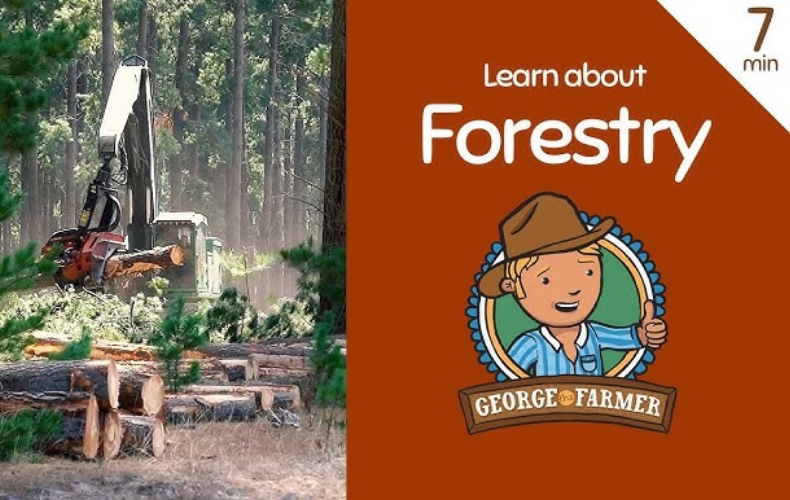
In plantations and agroforests (woodlots on farms), improvements in soil cultivation and early management (silvicultural) techniques including the judicious use of fertilisers and herbicides, along with tree breeding (genetic science), has driven a dramatic increase in the amount of wood able to be grown and drawn upon for a whole range of societal needs. Most plantations and woodlots are single species monocultures and on good sites they can produce hundreds of cubic metres of wood from every hectare, harvestable at 25 to 40 year intervals, and often with intermediate thinning along the way.

more topics

Forestry Matters!

Forestry matters! is a free, comprehensive education resource that provides teachers with relevant,  up-to-date information about South Australia’s forests.

To download this file

Harvesting and regenerating state forests

Find out about dry eucalypt forests and regeneration.

To download this file

Native timber harvesting in Central Highlands

VicForests’ Central Highlands region covers more than five million hectares across the central, north-east and south-east part of Victoria.  Find out more.

To download this file

Plantations fact sheet

Find out about Australian plantations: history, area, ownership and more.

To download this file

Products from timber

How we use timber products from paper, furniture to housing frames.

To download this file

Regenerating Victoria's forests

Did you know that VicForests re-seeds and replants trees in all areas where harvesting takes place to ensure the forest grows back? Find out more.

To download this file

Victoria's native timber industry

Find out more about Victoria's native timber industry.

To download this file
back to top

Forests and Carbon - Grow, Harvest Store

Use this poster to explain the the carbon cycle.

To download this file

The pine plantation rotation

What happens in a pine plantation rotation from 0 years- 35years.  Find out through this poster resource.

To download this file
back to top

Forestry Matters!

Forestry matters! is a free, comprehensive education resource that provides teachers with relevant,  up-to-date information about South Australia’s forests.

To download this file

Forests and forestry in NSW facts and worksheet

Factsheet and worksheet to guide discussions around Forests and Forestry in NSW. 

To download this file

Planet Ark - Schools Tree day

Each year in July, around 2500 schools across Australia take part in Schools Tree Day. Students nation-wide have learnt how to plant, and care for the seedlings they grow. Become involved.

Tackle climate change, use wood

This website provides a downloadable video and information book on how using wood helps tackle climate change, produced by the British Columbian Forestry Climate Change Working Group in Canada. It discusses how wood products store carbon for the life of a product, and if used as a substitute to replace fossil fuel intensive materials such as concrete and steel, it helps reduce the amount of greenhouse gases released into the atmosphere. Wood is a renewable, recyclable, and sustainable natural product for the long term.

Timber harvesting in native State forests- Factsheet and Worksheet

A combined fact and work sheet for students to explore questions relating to timber harvesting in native State forests.

To download this file

Wild Forest Adventure Activity Book

Wild Forest Adventure is an activity based companion booklet especially designed for use with the Forests NSW website.

To download this file

Wild Forest Adventure online game

The Wild Forest Adventure section has been especially designed for students, to provide interesting and relevant information about the forest environment, in a stimulating and fun way.

back to top

Forestry Matters! website

Forestry matters! is a free, comprehensive education resource that provides teachers with relevant,  up-to-date information about South Australia’s forests.

Planet Ark - Schools Tree day

Each year in July, around 2500 schools across Australia take part in Schools Tree Day. Students nation-wide have learnt how to plant, and care for the seedlings they grow. Become involved.

Planet Ark's Make It Wood - Do Your World Some Good

This website developed by Planet Ark provides a wealth of information regarding sustainably sourced timber.

Tackle climate change, use wood

This website provides a downloadable video and information book on how using wood helps tackle climate change, produced by the British Columbian Forestry Climate Change Working Group in Canada. It discusses how wood products store carbon for the life of a product, and if used as a substitute to replace fossil fuel intensive materials such as concrete and steel, it helps reduce the amount of greenhouse gases released into the atmosphere. Wood is a renewable, recyclable, and sustainable natural product for the long term.

The story of carbon.

Carbie the carbon atom is not happy. It is getting crowded in the atmosphere causing it to warm up. Carbie is looking for a better place to be. This interactive game allows you to choose between the ocean, coal, trees and wood products and learn how carbon is stored in each of these environments. 
 

Wood.Naturally Better

Wood. Naturally Better.™ is a program designed to help professionals and consumers understand how they can play a part in tackling climate change by using one of the most natural materials – wood.

WoodSolutions

WoodSolutions is designed to provide information on timber and timber products to professionals and companies involved in building design and construction.

back to top

2. Multi Media task: Value adding to wood

When trees are harvested, the various parts of the tree are graded for different end uses as seen in this 'Going Bush' series video on value adding. Technological advances have helped mechanise harvesting and processing operations. Tree replanting is conducted after harvest to assist with forest regeneration. Forest Ecologists are the scientists that help with identifying rare and endgangered species to ensure areas of forest remain for habitat protection.

To download this file

Going Bush - A timber product for the future from an antique Newcastle factory

We visit a factory near Newcastle that looks as ominous as a horror movie set … and that’s just what it doubled as for the filming of Tomorrow when the war began a few years back. But from this archaic looking mill comes an all-natural cladding product fit for the 21st century.

To watch this video

Going Bush - Various demand for plantation and native forests

The importance for balance in consideration of native and plantation forests is explored from a Victorian perspective, where the main players say there will always be demand for resource from both.

To watch this video

Tackle climate change, use wood

This website provides a downloadable video and information book on how using wood helps tackle climate change, produced by the British Columbian Forestry Climate Change Working Group in Canada. It discusses how wood products store carbon for the life of a product, and if used as a substitute to replace fossil fuel intensive materials such as concrete and steel, it helps reduce the amount of greenhouse gases released into the atmosphere. Wood is a renewable, recyclable, and sustainable natural product for the long term.

The story of carbon.

Carbie the carbon atom is not happy. It is getting crowded in the atmosphere causing it to warm up. Carbie is looking for a better place to be. This interactive game allows you to choose between the ocean, coal, trees and wood products and learn how carbon is stored in each of these environments. 
 

Wild Forest Adventure online game

The Wild Forest Adventure section has been especially designed for students, to provide interesting and relevant information about the forest environment, in a stimulating and fun way.

back to top

Forest, wood and Australian carbon balance

Information on the extend to which plantations and commerical forests, as well as the wood products produced by those forests, contribute to Australia's carbon balance.

To download this file

Future-proofing Australia’s economy: the case for bio-alcohols for transport

Industry report on the case for bio-fuels.

To download this file
back to top
X
Loading